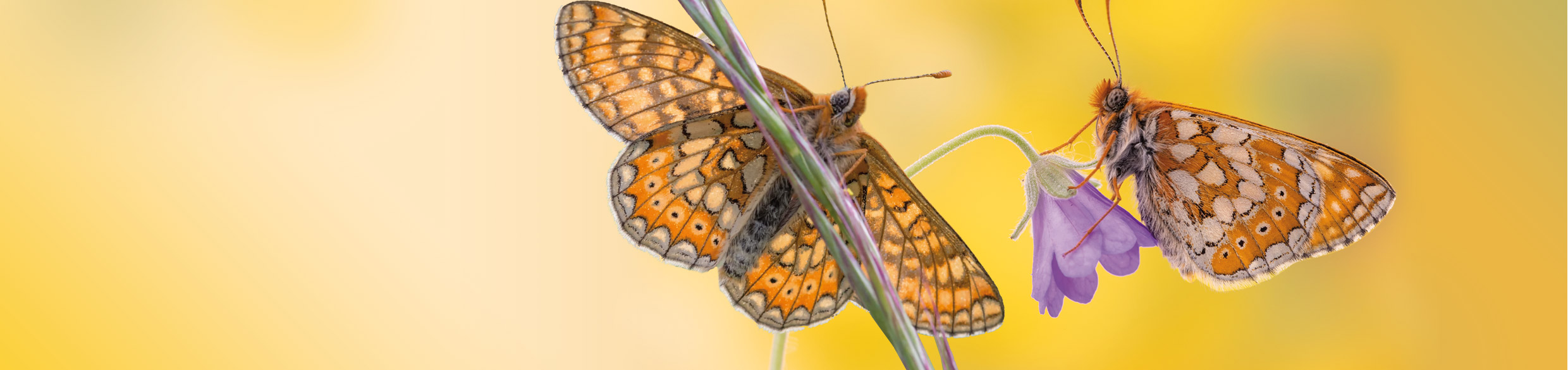


Golden Fritillary (Euphydryas aurinia)
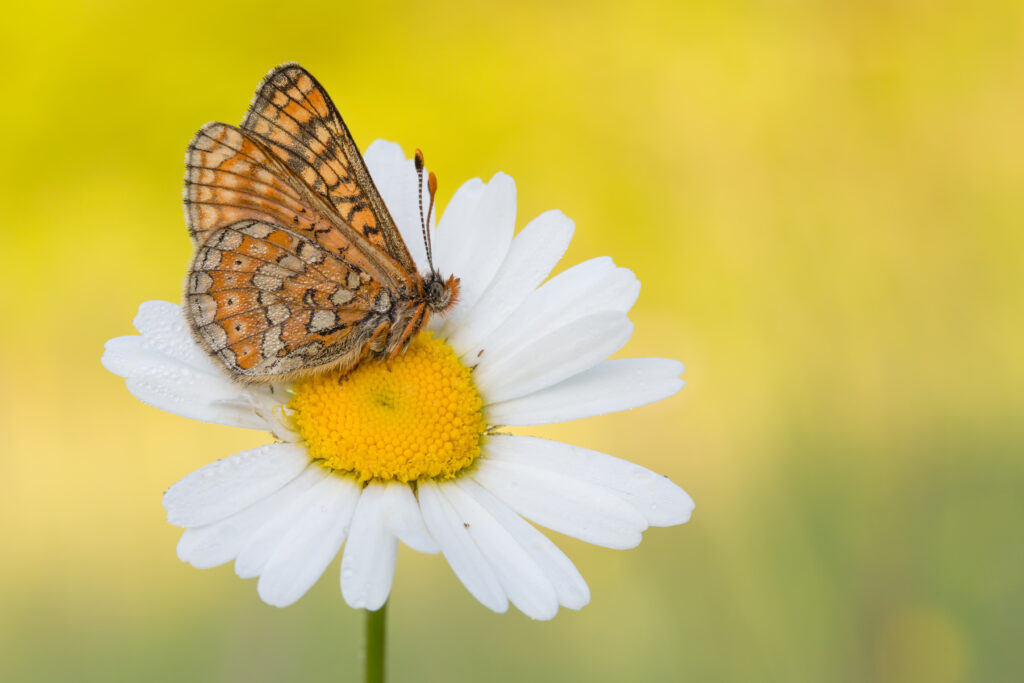
On its upper side, the Golden Fritillary displays a colourful wing pattern consisting of orange, yellow as well as black-brown patches. A distinctive feature is the orange-red band adorned with a line of black dots along the edge of the hindwing.
Habitat
The Golden Fritillary is found in both wet and dry locations, but in both cases it only inhabits extensively used, nutrient-poor grassland areas with patchy, low vegetation. In the “wet meadow type” the species occurs at the edges of high or low moors, in calcareous fens, reedgrass meadows, Plume Thistle meadows along streams and similar wet grasslands. In the “dry grassland type” it lives along xerothermic slopes with open or bushy semi-dry grasslands on chalk or chalky loess. For successful habitat management of Euphydryas aurinia, it is crucial to consider that the species apparently uses different microhabitats for feeding and egg-laying.
Life Cycle
The flight period of the Golden Fritillary extends from mid-May to July. During this time, females lay several hundred eggs in multi-layered clutches on the leaves of the Small Scabious (Scabiosa columbaria) or Devil’s-bit Scabious (Succisa pratensis). After about four weeks, the caterpillars hatch and, within a few days, begin to create a communal silk web on the host plant. The social caterpillars live together during the first four larval stages. In August/September, the caterpillars start building a hibernation web among the ground vegetation. Following winter dormancy, they continue their development as solitary individuals. Pupation occurs from mid-April on stems or leaves of ground vegetation, so that the next generation of butterflies emerges in May
Threats / Conservation
In North Rhine-Westphalia, the Scabious Fritillary is “critically endangered” (https://ffh-arten.naturschutzinformationen.nrw.de/ffh-arten/de/arten/gruppe/schmetterlinge/kurzbeschreibung/107917). Once common, the species is now extinct in the Euskirchen district.
Captive rearing of the Golden Fritillary
A TV report on channel WDR5 about the search for caterpillars for captive rearing of the Golden Fritillary as part of the two LIFE projects “Helle Eifeltäler” and “LIFE4Siegerlandscapes”: